
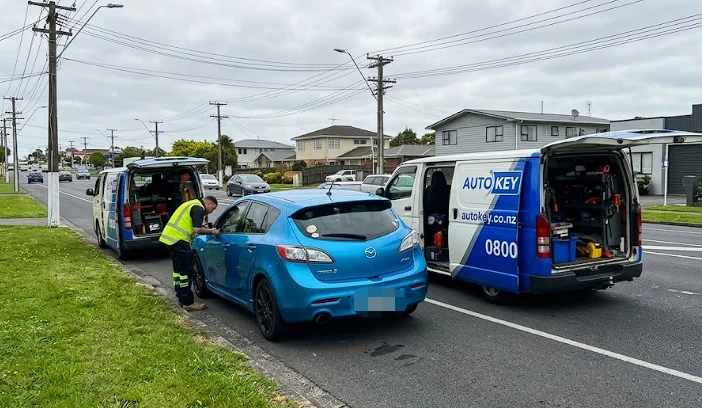
It was a crisp October afternoon on a busy roadside in Manurewa, South Auckland, when we received an urgent call: the driver of a blue 2009 Mazda 3 (Axela) was stranded on the side of the road and the car would not start.
Job details
| Vehicle | Mazda 3 (Axela) hatchback |
| Year | 2009 |
| Suburb | Manurewa, South Auckland |
| Problem | Car stopped recognising a badly matched spare key (semi-smart key system) |
| Service | Deleted the faulty key and programmed a new semi-smart key on site |
| Response | On site within 30 minutes |
| Date | October 2026 |
The situation
The driver had recently bought a cheap, poorly matched “spare” key from an inexperienced provider. Everything seemed fine – until they parked, shut off the engine and tried to start the car again. Nothing. The car refused to recognise the key, leaving them completely stranded on the roadside.
To make matters worse, several other Auckland key services had already turned them down, saying this model was “impossible to program” on the roadside. Fortunately, they called AutoKey on 0800 110 119. Within 30 minutes our mobile team arrived in Manurewa with advanced diagnostic equipment to get this tricky Mazda back on the road.
Why 2008–2013 Mazdas are a nightmare for most locksmiths
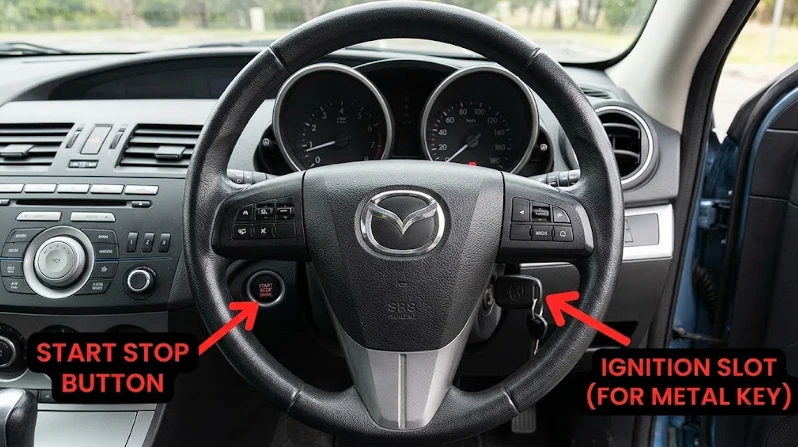
Many drivers – and even experienced locksmiths – don’t realise that a number of Mazdas built between roughly 2008 and 2013, including the Mazda 3 (Axela), Mazda 6 (Atenza) and Demio, use a unique and complex “semi-smart” key system. Unlike modern push-to-start cars, these transition-era models need two separate ignition parts to work together:
- The ignition slot (right side): you insert the mechanical/transponder key into the slot at the bottom right of the steering column.
- The START/STOP button (left side): once the key is inserted, you press the START/STOP button on the left of the steering wheel to start the engine.
The diagram below shows this unusual dual-ignition set-up on the dashboard.
Because of this hybrid set-up, the remote and the immobiliser transponder must be perfectly synced using specialised, high-end diagnostic equipment. Most general roadside key services don’t carry the specialised OEM keys these cars need (we use original Sanyou 30 OEM keys) or the software to pair them. If a sub-standard key is used, or it isn’t programmed correctly, the car can quickly lose sync and leave you stranded – exactly what happened to our customer in Manurewa.
How we solved it on the roadside
- No tow and no dashboard removal – the whole job was done at the roadside.
- Deleted the faulty, badly matched key from the car’s memory.
- Programmed a brand-new semi-smart key using a genuine Sanyou 30 OEM key.
- Programmed the remote functions and verified the transponder in the ignition slot.
- Tested the “insert-and-push” starting sequence until it worked flawlessly.
Result & tip for owners
The customer was back on their way the same afternoon – without the stress and high cost of a tow to the dealership.
Tip: if your Mazda uses the insert-and-push system, don’t settle for a cheap, unmatched spare – a badly programmed key can work for a while and then suddenly stop. Whether you’ve lost your only key (all keys lost), have a damaged remote or simply need a reliable, professionally matched spare for your Mazda, we’ve got Auckland covered.
Lost your car keys too? We come to you.
Mobile car key service across Auckland – all keys lost, spare smart keys, lockouts and programming. No towing needed.
Related: Lost all your car keys in Auckland? · Car key FAQ · More of our jobs